Description
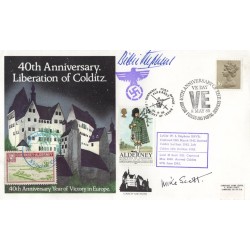
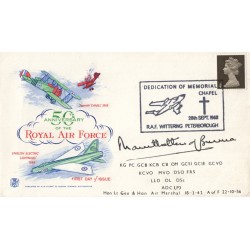
RAF Escaping Society FDC signed by SOE chief Maurice Buckmaster, his assistant Vera Atkins and SOE agent Francis Cammaerts
Francis Charles Albert Cammaerts, DSO (16 June 1916 – 3 July 2006), code named Roger, was an agent of the United Kingdom's clandestine Special Operations Executive (SOE) during World War II. The purpose of SOE was to conduct espionage, sabotage and reconnaissance in occupied Europe and Asia against the Axis powers, especially Nazi Germany. In France, SOE agents allied themselves with French Resistance groups and supplied them with weapons and equipment parachuted in from England. Cammaerts was the creator and the organiser (leader) of the Jockey network (or circuit) in southeastern France in 1943 and 1944.
At the beginning of World War II in 1939, Cammaerts declared himself a conscientious objector, but in 1942 he joined the SOE. He recruited and supplied with arms and training a large number of resistance networks and cells over an extensive area east of the Rhone River extending to the border with Italy and north from the Mediterranean Sea to the city of Grenoble. Despite being very careful in his work, Cammaerts was captured by the Germans in August 1944, but saved from execution by his courier, Christine Granville.
Of the more than 450 SOE agents who worked in France during World War II, M.R.D. Foot, the official historian of the SOE, named Cammaerts as one of the half-dozen best male agents. He was one of only three SOE agents to be promoted to the rank of Lt. Colonel, along with George Starr and Richard Heslop
Colonel Maurice James Buckmaster OBE (11 January 1902 – 17 April 1992) was the leader of the French section of Special Operations Executive and was awarded the Croix de Guerre
Vera May Atkins, CBE (16 June 1908 – 24 June 2000) was a British intelligence officer who worked in the French Section of the Special Operations Executive (SOE) from 1941 to 1945 during the Second World War.
Though not a British national, in February 1941 Atkins joined the French section of the SOE as a secretary. She soon was made assistant to section head Colonel Maurice Buckmaster, and became a de facto intelligence officer. She served as a civilian until August 1944, when she was commissioned a Flight Officer in the Women's Auxiliary Air Force (WAAF). In February 1944 Atkins was naturalised as a British subject. She was later appointed F Section's intelligence officer (F-Int).
Atkins' primary role at SOE was the recruitment and deployment of British agents in occupied France. She also had responsibility for the 37 women SOE agents who worked as couriers and wireless operators for the various circuits established by SOE. Atkins would take care of the "housekeeping" related to the agent, such as checking their clothing and papers to insure they were appropriate for the mission, sending out pre-written anodyne letters at regular intervals, acting as SOE's liaison with their families and ensuring they received their pay. Atkins would often accompany agents to the airfields from which they would depart for France, and would carry out final security checks before waving them off.
Atkins always attended the daily section heads meeting chaired by Buckmaster, and would often stay late into the night at the signals room to await the decoded transmissions sent by agents in the field. She would usually arrive at F Section's Baker Street office around 10.00 am. Although not popular with many of her colleagues, she was trusted by Buckmaster for her integrity, exceptional memory and good organisational skills