Description
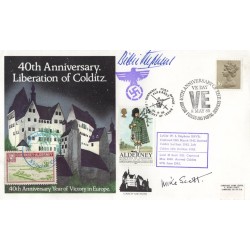
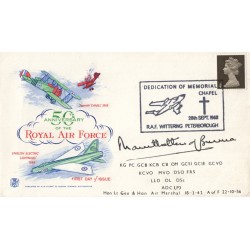
RAF Escaping Society FDC signed by several resistance heroes including O’Leary line creator and leader Pat O’Leary, Jan de Blommaert, Andree Dumon (given the codename “Nadine” to avoid confusuion with Andree de Jongh, Michelle Ugoux, Comete Line courier and later MI9 agent Georges D’Outremont and Jacques Le Grelle who took over the Paris sector of the Comete Line after the arrest of Frederic De Jongh
Andrée Dumon (5 September 1922 – 30 January 2025), codenamed Nadine, was a Belgian Resistance fighter during World War II. She was captured and sent to Ravensbrück and Mauthausen concentration camps but survived.
Dumon was born in Belgium and raised in the Belgian Congo, where her father was a doctor. She returned to Belgium to train as a nurse. Aged 17 at the start of World War II, she joined the Comet Line escape network for Allied airmen and others, of which her father and sister were members. Her family was betrayed in August 1942 and her father was killed.
The Comet Line saved the lives of hundreds of airmen and soldiers. Dumon's service in the war resulted in her receiving an honorary Order of the British Empire and the US Medal of Freedom. Her memoirs were published in 2018.
Andrée Marie Dumon, was born in the Uccle municipality of Brussels on 5 September 1922, the daughter of Eugene Dumon and Marie (née Plessix), a nurse. Dumon spent six years as a child in the Belgian Congo where her father was a doctor. The family returned to Belgium to enable her to train as a nurse. She was educated at the Royal Atheneum School in Uccle.
Dumon was aged 17 when Nazi Germany invaded Poland in 1939 and was outraged when Belgium capitulated in 1940. She joined the Resistance and became a member of the "Réseau Comète" (Comet Line), whose members guided shot-down Allied airmen, Belgian secret agents and others to a network of safe houses and helped them to escape to neutral countries. Her father was one of the leaders of the Luc-Marc intelligence network. Her sister Micheline Dumon, code-named Lily (died 2017), was in the Comet Line and after the war was awarded the George Medal for her work. Dumon was given the codename Nadine to avoid confusion with fellow resistance member Andrée de Jongh.
At first Dumon was responsible for finding food, clothing and shelter, and organising medical care and fake identity cards, but before long she was escorting Allied airmen through occupied Brussels to safe houses, under the noses of German soldiers. She recalled that being nervous was not an option. "I was very happy to do something. I had no time to be afraid." By 1941 she was accompanying British, Canadian, Australian and American airmen on nerve-wracking train journeys to Paris, from where they would escape through the Pyrenees to Spain.
The Germans knew that downed airmen were receiving help from the local population, and eventually tracked down and arrested more than 700 members of the Comet Line. More than 300 of them were killed. On 11 August 1942, the Dumon family were betrayed by a former member of the Comet Line and the Dumons were arrested and questioned, but Andrée maintained silence, even when beaten and threatened with execution. Her father was taken away and murdered in Gross-Rosen concentration camp. Dumon was held in the prisons of Trier, Cologne, Mesum, Zweibrucken and Essen, before being sent to Gross-Strehlitz concentration camp. She escaped from Gross-Strehlitz, but was betrayed by a farmer and recaptured. She was sent to Ravensbruck concentration camp in Germany and then to Mauthausen concentration camp in Austria, a four-day journey in bitter cold. When she arrived she collapsed in the snow, but was supported by other prisoners to prevent her being killed as an invalid. Dumon was freed from Mauthausen in April 1945, aged 22, suffering from typhus. It took her two years to recover, and it had been expected that she would die
Count Le Grelle worked for an Escape Organisation for seven and a half months, and during that time rendered invaluable service to the Allied Cause.
The Line was badly penetrated by the Gestapo early in 1943 and some of its principle members were arrested. Count Le Grelle was sent to France at the end of May with the mission of helping to re-organise the evacuation of Allied Service personnel, and in particular of looking after the PARIS sector. His task there was as varied as it was complicated. He had to plan the arrival of evaders from Brussels and from the French provinces, and their departure for Spain via Bordeaux. It was his responsibility to arrange for the lodging, clothing and feeding of evaders in Paris, toe ensure their security, to interrogate them on their identities, to provide them with false papers and to get them photographed.
He had to organise a system of intelligence whereby he learned of the change in the controls on trains, and of all matters which the Germans instigated at short notice to prevent just such work as he himself was engaged on.
From shortly after his arrival until his arrest on 12th January 1944, Count Le Grelle handled a very large number of evaders in the PARIS area, at a time when, through the intensified programs of bombardment, there were far more casualties than ever before, and it was thanks to his superb organising ability that PARIS, the vital link in the chain Brussels - Spain, was able to function so effectively.
After his arrest Count Le Grelle was tortured by the Germans and sentenced to death and sent to Germany where he passed through many prisons. He returned to Belgium on 8th June 1945.
Count Le Grelle showed at all timed outstanding courage and resource. It is entirely due to his untiring efforts that large numbers of Allied evaders and escapers were able to regain their freedom."