Description
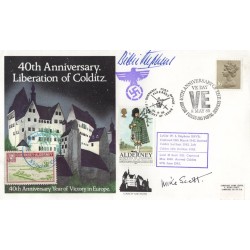
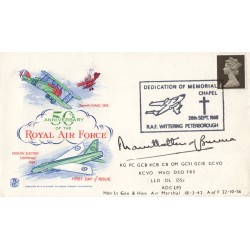
RAF Escaping Society cover dedicated to the Dutch-Paris Line, signed by FOUR veterans of the line, Joseph Le Jeune, one of the leaders of the Amsterdam-Brussells sector, Father E.H.J ann Der Stegge who escorted many Allied soldiers through the Toulouse area, Hans Wisbrun who collected evaders in Holland and escorted them to a safe house in Brussells and then escorting them on to Paris, finally signed by Paul Philip Veerman who escorted many allied soldiers and 'persons in danger' at much risk to himself, having on one occasion to flee from Holland to Switzerland. After returning in 1943 he was eventually captured by the Gestapo and was in 12 different places of imprisonment over the next 12 months, miraculously surviving the war
Also signed by Dutch-Paris line founder and leader, John Weidner who’s signature is VERY rare. He only signed SIX of these covers. We are lucky to have two left and don’t think we’ll ever see one again
POSTAGE OVERSEAS BY COURIER ONLY
Johan Hendrik Weidner (October 22, 1912, in Brussels, Belgium – May 21, 1994, in Monterey Park, California, United States) was a highly decorated Dutch hero of World War II.
At the outbreak of World War II Jean was living in Paris. With the subsequent German occupation of France he fled with several others from Paris to Lyon in the unoccupied part of France. Because he had to abandon his Parisian business, he began a new business in Lyon. In 1941, Jean founded "Dutch-Paris", an underground network of which the location of his Lyonnaise textile business soon became its headquarters. In order to get passes to go in and out of the Swiss frontier zone, he set up a second textile shop in Annecy at the end of 1942.
Dutch-Paris became one of the largest and most successful underground networks for people persecuted for faith or race, Allied pilots, and persons of great Dutch importance to help them escape via Switzerland and Spain. This escape route was also used for smuggling documents. In the Netherlands this message line was also known as "The Swiss Way".
In its heyday, 300 people were part of this underground network, of which about 150 people were arrested. 40 people were slain or died from the effects of captivity, including his sister who helped to coordinate escapes from Paris. The escape route has greatly contributed to the French Resistance, and is responsible for the rescue of more than 1,080 people, including 800 Dutch Jews and more than 112 downed Allied pilots. Jean was one of the most sought after underground leaders of France, for whom the Gestapo at one time offered a reward of five million francs for his arrest.
In February 1944, a young female courier was arrested by the French police and extradited to the Gestapo. Against all rules, she had a notebook with her containing names and addresses of Dutch-Paris members. She was brutally interrogated by a guard that held her head under cold water until she nearly drowned. Under torture she revealed many names of key members of the underground network. As a result, a large number of Dutch-Paris members were arrested (See more details in Suzanne Hiltermann-Souloumiac).
The name of Jean's sister Gabrielle Weidner was among the names listed in the notepad. She was arrested by the Gestapo and imprisoned at the Fresnes prison in Paris, because it was hoped for that her comrades would try to free her. In Fresnes she was treated well, but when this ploy did not work, she was shipped to Ravensbrück concentration camp in Germany. She later died of the effects of malnutrition, only a few days after liberation by the Russians.
During the occupation, Jean was arrested by both French gendarmerie and French Milice, including the Swiss border police. The French gendarmerie beat him up brutally, but they had to release him later due to lack of evidence. In another arrest by the Milice in Toulouse he was tortured, but he managed to escape before they could transfer him to the Gestapo. The Gestapo were never able to get a hold of him