Description
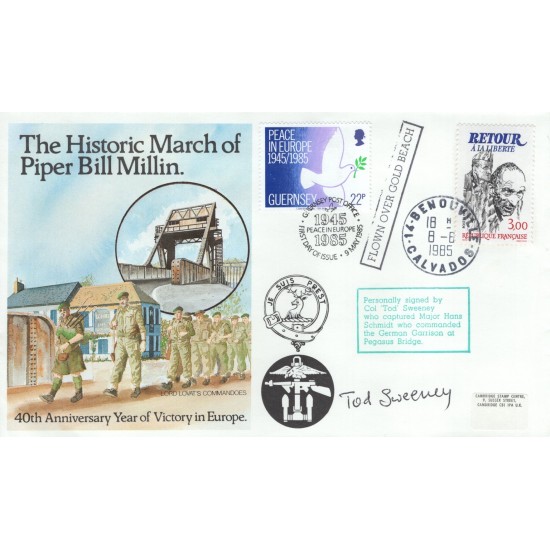
Historic March of Piper Bill Millin cover signed by Colonel Tod Sweeney who took part in the initial assault on Pegasus Bridge on 6th June 1944 and was on the third glider to land.
Colonel Henry John Sweeney MC (1 June 1919 – 4 June 2001), known as Tod Sweeney, was an officer of the British Army. During the Second World War he was a platoon commander in the coup de main operation, by gliderborne troops of the 2nd Battalion, Oxfordshire and Buckinghamshire Light Infantry (the 52nd), on D-Day, 6 June 1944, tasked to seize Horsa Bridge and Pegasus Bridge before the main assault on the Normandy beaches began. The following day he was awarded the Military Cross for rescuing a wounded member of his platoon while under heavy fire near Escoville. Sweeney commanded the 1st Green Jackets (43rd and 52nd) at Penang from April 1962 to January 1964; during the Brunei Revolt and Indonesia-Malaysia confrontation.
Henry John Sweeney was born in Blyth, Northumberland, England, on 1 June 1919, and educated at Douai School, Berkshire. He entered Douai Abbey as a novice monk. At the outbreak of the Second World War in September 1939 he enlisted in the British Army's Royal Army Pay Corps, later volunteering to join the infantry. Sweeney was commissioned as a second lieutenant into the Royal Northumberland Fusiliers on 13 September 1941 and shortly afterwards transferred to the Oxfordshire and Buckinghamshire Light Infantry (OBLI), joining the 2nd (Airlanding) Battalion (the 52nd) in April 1942. At the time the battalion was assigned to the 1st Airlanding Brigade, part of the 1st Airborne Division, and converted into a glider infantry role.
In May 1943 the battalion transferred from the 1st Airborne Division to 6th Airlanding Brigade, of the newly formed 6th Airborne Division. He was a platoon commander in Major John Howard's 'D' Company coup de main that captured the Caen canal and Orne river bridges during Normandy landings on 6 June 1944. The task was to seize Bénouville bridge, now known as Pegasus Bridge, over the Caen canal and Ranville bridge, now known as Horsa Bridge, over the River Orne. Sweeney and his No. 23 platoon's objective was, with two other platoons, to capture the Ranville bridge.
On D-Day his platoon landed approximately 500 yards from Ranville bridge. On arrival at the bridge, he left one section on the west bank and crossed the bridge with the other two sections. He met up with Lieutenant Dennis Fox on the far side of the bridge and found Fox's platoon in control of the bridge and surrounding area. By 00.26 hours on D-Day both bridges had been secured. The operation to capture the bridges was portrayed in the film The Longest Day (1962).
Sweeney was awarded the Military Cross (MC) for rescuing a wounded corporal of his platoon on 7 June 1944 while under heavy fire near Escoville. Sweeney was wounded during the Battle of Normandy in July 1944 and was evacuated to England. He rejoined the 2nd Oxfordshire and Buckinghamshire Light Infantry (the 52nd) in October 1944. He served in the Ardennes and the Netherlands from December 1944 to February 1945