Description
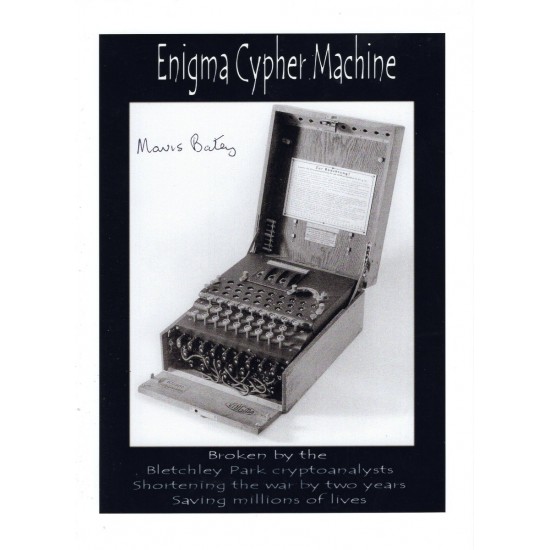
8x6 inch photo hand signed by Bletchley Park codebreaker Mavis Batey
Mavis Lilian Batey, MBE (née Lever; 5 May 1921 – 12 November 2013), was an English code-breaker during World War II. She was one of the leading female codebreakers at Bletchley Park.
She later became a historian of gardening who campaigned to save historic parks and gardens, and an author. Batey was awarded the Veitch Memorial Medal in 1985, and made a Member of the Order of the British Empire (MBE) in 1987, in both cases for her work on the conservation of gardens
At first she was employed by the London Section to check the personal columns of The Times for coded spy messages. Then, in 1940, she was recruited to work as a codebreaker at Bletchley Park. She worked as an assistant to Dilly Knox, and was closely involved in the decryption effort before the Battle of Matapan. According to The Daily Telegraph, she became so familiar with the styles of individual enemy operators that she could determine that two of them had a girlfriend called Rosa. Batey had developed a successful technique that could be used elsewhere.
Although Batey was just 19, she started working on the Italian Naval Enigma machine, and by late March 1941 she effectively broke into their framework, deciphering a message which said "Today's the day minus three". She and her colleagues worked for three days and nights and discovered that the Italians were intending to assault a Royal Navy convoy transporting supplies from Cairo, Egypt to Greece. The messages they deciphered provided a detailed plan of the Italian assault, which led to the destruction by an Allied force of much of the Italian naval force off Cape Matapan, on the coast of Greece. The leader of the Matapan attack, Admiral Andrew Cunningham, later visited Bletchley Park to thank Knox, Batey, and her fellow code-breakers for making his victory possible.
Apart from being a talented code-breaker (he had broken the Zimmermann Telegram in World War I), Knox was a noted classics scholar, and wrote a poem to celebrate the Allied success at Matapan. He included a stanza dedicated to Batey and the key role she had played in the victory:
"When Cunningham won at Matapan, By the grace of God and Mavis, 'Nigro simillima cygno est,' praise Heaven, A very 'rara avis.' " ("Like the black swan, she is, praise heaven, a very rare bird".) It was, she later said, "very heady stuff for a 19-year-old".
In December 1941 she broke a message between Belgrade and Berlin that enabled Knox's team to work out the wiring of the Abwehr Enigma, an Enigma machine previously thought to be unbreakable. Later, Batey broke another Abwehr machine, the GGG. This enabled the British to be able to read the Abwehr messages and confirm that the Germans believed the Double-Cross intelligence they were being fed by the double agents who were recruited by Britain as spies. While at Bletchley Park she met Keith Batey, a mathematician and fellow codebreaker whom she married in 1942